

Skip to content
Movemental Partner
Skip to content
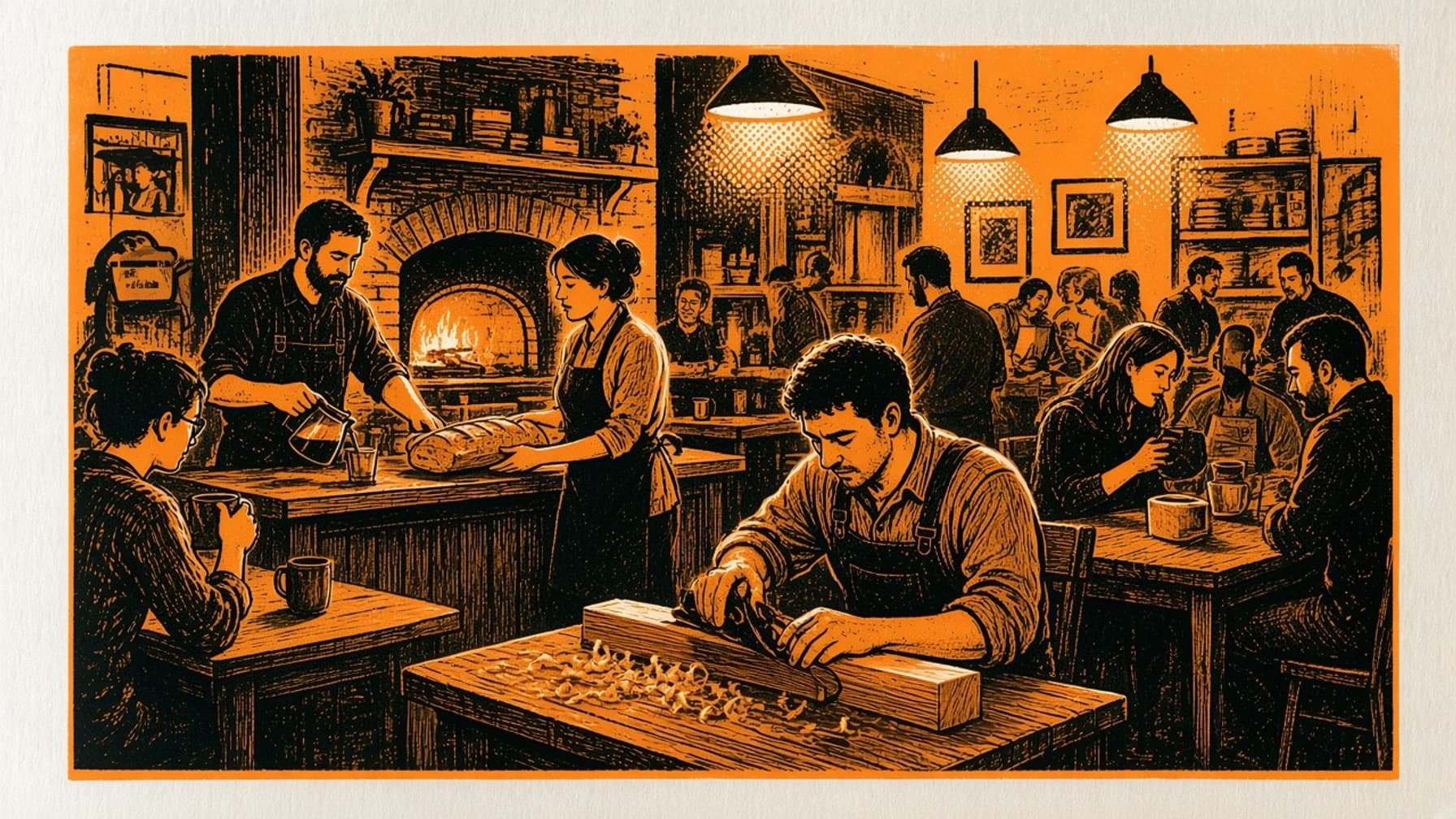
Bi-Vocational and Marketplace Mission hero artwork
Theme 5 of 5

Bi-Vocational and Marketplace Mission

The future of the church belongs to leaders who work real jobs, build real things, and plant their lives inside the culture they are trying to reach.

Understand

Overview

The Church Built by Peasant Leaders

Most of us grew up inside a model that assumed the more money you raised and the more staff you hired, the more God could work. We built larger buildings, printed larger bulletins, and hired larger teams, and the result was a church that consumed almost everything it generated just to keep itself running. Meanwhile, the actual work of the kingdom, knowing your neighbors, blessing your street, sitting long enough at a table for real conversation to happen, got quietly squeezed out by the machinery of keeping the institution alive.

Paul knew something we have mostly forgotten. He made tents. He worked with his hands in the same city where he was planting a church, and he did it on purpose. In 1 Thessalonians 2:9, he chose to work among people to avoid being a burden to those he was teaching the gospel. He was not embarrassed by his trade. He used it. The marketplace was not a distraction from his mission; it was the environment of his mission. And the Trappist monks understood the same thing a thousand years later, baking bread, crafting beer, raising livestock, and hosting guests as a way of funding their calling and blessing the city at the same time.

Bi-Vocational and Marketplace Mission is not a survival strategy for underfunded church planters. It is a deliberate, theologically grounded decision to embed your life and your work inside the culture you are trying to reach, so that the gospel has a geography, a street address, a storefront, a table where people actually sit. When you work a real job in a real neighborhood, you do not have to manufacture proximity to secular people. You already have it. Every conversation at the counter, every shared lunch break, every moment you show up as a human being rather than a religious professional is a moment the kingdom becomes tangible.

This is the vision behind the BiVO Blueprint: a network of leaders who are self-funded through honest work, who run community enterprises that bless the local economy, and who build the kind of church that does not require a building or a budget to function. God has set up his mission to be, as we discovered at Adullam, mostly free of charge, what it costs is not money, but the willingness to show up, stay put, and do the work.

Core Question

How can your vocation or business become the primary engine and environment for your neighborhood mission, so that your work and your calling are no longer two things pulling against each other?

The usual question

How do I balance a job and ministry at the same time without burning out?

The way someone finds the sacred is when they see God use their secular vocation and lot in life.
Hugh Halter, BiVO
The Model

The BiVO Blueprint

The BiVO Blueprint is not a theory. It came out of watching a network of leaders in Denver work real jobs, raise real families, and build a congregation of around four hundred people on a monthly budget that most churches spend on a single staff salary. It has four moving parts, and every one of them has to be working before the whole thing holds together.

  1. 01

    Marketplace Craft

    This is not a cover story. Paul made tents. The Trappists baked bread and crafted beer. Joey Turner in Fort Worth built a community pub that the locals loved before they ever heard a sermon. Your trade or business is the place where you earn trust, create genuine value, and spend your Tuesday as a neighbor rather than a religious professional. The marketplace gives you proximity that no church program can manufacture.

  2. 02

    Third-Place Incubation

    A coffeehouse, a pub, a neighborhood co-op, a backyard, any space where people who would never walk through a church door can show up without any weird spiritual overtones. Jesus was brilliant at this. He reclined at tables, attended weddings, and showed up wherever regular people gathered. Third places are not bait-and-switch evangelism; they are the natural environment of inclusive community, which is one third of the kingdom DNA that most attractional churches never deliver.

  3. 03

    Sustainable Economics

    The old funding model asked people to give so the institution could keep its lights on and its staff paid. The BiVO model flips that. When leaders are self-funded, the congregation's giving can go almost entirely to the neighborhood and to the poor, which is closer to the original design of the tithe than anything most churches practice today. At Adullam, a full congregational network ran on what many churches spend on a single program.

  4. 04

    Embedded Witness

    This is what gets lost when leaders are extracted from the culture and put behind a desk in a church building. Embedded witness is not an event or a program; it is the accumulated weight of showing up, at the counter, on the job site, at the school sideline, as someone whose life is visibly different and genuinely good. You cannot manufacture it from a stage. It only happens when you are actually in the room, day after day, with people who have never been to a church service.

Manna or Mammon

Feudal Church FundingBiVO Marketplace Mission
Who does the ministryFeudal Church FundingPaid professionals set apart to do the work that ordinary people cannotBiVO Marketplace MissionA network of saints who work normal jobs and serve twenty to twenty-five hours a week as missionaries in their own spheres
How the church is fundedFeudal Church FundingTithe-dependent salary structures where ninety percent of giving covers pastoral pay and building costsBiVO Marketplace MissionSelf-funded leaders who earn their own income so giving can flow outward to the neighborhood and the poor
What success looks likeFeudal Church FundingAttendance numbers, weekend production quality, and the ability to keep the lights on and the staff paidBiVO Marketplace MissionHow many apprentices of Jesus are scattered across the city on Monday through Saturday, embedded in workplaces, pubs, and front porches
Risk and resilienceFeudal Church FundingForty church plants given $250,000 each, with one success story after five years and $10,000,000 spentBiVO Marketplace MissionStarting with no money and no pressure, letting God build something naturally through relationships before any congregational structure forms
Relationship to the cultureFeudal Church FundingLeaders inside a building, set apart from the nine-to-five world, with limited credibility among people who work for a livingBiVO Marketplace MissionLeaders embedded in the marketplace who earn street credibility because they share the same economic pressures, workplaces, and neighborhoods as their neighbors
Discipleship outcomeFeudal Church FundingChurch attenders who consume services and do not create disciples, producing what the book calls a futile processBiVO Marketplace MissionDisciples who find meaning when God uses their secular vocation, waking up prayerfully to see what the kingdom can do through a plumber, a nurse, or a poker dealer

The old model asks people to fund a system so professionals can do ministry on their behalf. The BiVO model asks every person to wake up to the fact that their job, their neighborhood, and their kitchen table are already the mission field.

Examine

Biblical Foundations

Workers, Not Pontiffs

Matthew 9:37-38

Historical Context

Peasant Leaders and the Long Game

6th century

Saint Benedict founds the Trappist monastic movement on ora et labora, building self-sufficient communities that baked bread, brewed beer, and blessed surrounding towns without depending on charity.

9th to 11th centuries

Trappist monasteries generate roughly twenty to thirty percent of medieval economic output through agricultural and creative enterprises, demonstrating that sacred work and marketplace productivity are not opposites.

1st century

Paul the tentmaker works among the people in Thessalonica and Corinth, choosing to earn his own living so that the gospel he preaches carries no financial strings and no burden on the communities he is forming.

Early 2000s

Hugh Halter and Matt Smay plant Adullam in Denver with a deliberately bi-vocational leadership structure, running the entire congregational network on roughly twelve to fifteen thousand dollars a month while Hugh averages twenty-five hours a week on church leadership and the rest on outside income.

2013

BiVO is published as a modern-day guide for bi-vocational saints, naming the pattern that Adullam had proved on the ground and equipping thousands of leaders to leverage business, family, and counter-culture mission as one integrated calling.

Field Studies

Stories From the Street

Bi-Vocational and Marketplace Mission is not a theory, it is a pattern that shows up wherever ordinary people decide to stop waiting for someone to fund their calling and start leveraging the life they already have.

Denver, Colorado

The D-Team That Built Adullam

When Hugh and Cheryl moved to Denver to plant what would become Adullam, the first decision was to refuse the standard church-plant funding model. They wrote bi-vocational orientation into their bylaws before they had a single regular attendee. Hugh painted houses and received one third of his income from the church, one third from speaking and training, and one third from Cheryl's real estate work. Matt, his original partner, worked FedEx, took five dollars an hour at a golf course, and pieced the rest from missionary support. Jason led worship for a decade at $300 a month, the equivalent of what a normal worship leader earns in a single year. Lou sold medical equipment and insurance instead of taking a church stipend, and seven years in was serving fifteen hours a week as an elder without pay. Nobody had a title. Nobody cared about personal success. The budget to run the entire network of incarnational communities across forty-five miles of Denver sat at twelve to fifteen thousand dollars a month. As Hugh writes in BiVO, 'We are a network of incarnational communities around Denver, and between the two congregational sites, we oversee about 400 people. It's not a huge story, but I think you'll agree it is a healthy one.'

Thessalonica and Corinth, 1st century

Paul's Tent and the Speculative Venture

Paul the tentmaker chose to work with his hands among the people he was forming into a church, refusing to take their money so that the gospel he carried would arrive without financial strings attached and without burdening a community that was just finding its footing.
Fort Worth, Texas

Joey Turner's Pub in Fort Worth

Joey Turner planted a small congregation and, knowing it would grow slowly, got investors to help build a community pub in the middle of old Fort Worth. The business became a major local hit, blessed multiple nonprofits, and gave his church a natural place to connect without the religious baggage that a church building would have carried.

Apply

Formation

Getting Your Hands Dirty

Step 1

Step 1

Audit your six knacks honestly: personal discipline, spousal buy-in, relational street credibility, spiritual grounding, financial reality, and the specific skills God can leverage through you.

Step 2

Step 2

Map your three leverage points, business for mission, family on mission, and counter-culture mission, and identify where each is already active in your week.

Step 3

Step 3

Start cheap: gather two or three committed friends willing to live the communion-community-mission rhythm together without waiting for a budget or a building.

Step 4

Step 4

Engage your neighborhood first with practical blessing and genuine hospitality, no spiritual strings attached, and let community form at its own pace.

Step 5

Step 5

Draw your manna-or-mammon line: restructure your finances so that trusting God for daily provision is still genuinely required, not rendered irrelevant by accumulated security.

Step 6

Step 6

If you are a leader, resist the reflex to hire someone to do what your whole community can do together, equipping people for the work multiplies far more than doing the work yourself.

Reflection

Questions That Might Change Your Life

Question 1 of 5

If you stopped receiving any financial benefit or social status from your ministry role, what would you keep doing, and what does your honest answer reveal about your actual motivations?

Go deeper

Watch for the Distortion

Ways This Gets Twisted

Bi-Vocational and Marketplace Mission attracts two kinds of misreaders: people who use it to feel superior to paid clergy, and people who treat it as a financial survival strategy rather than a kingdom conviction. Both miss the point entirely.

BiVO as a badge against paid pastors

The goal is not to make full-time clergy feel guilty. Paul said making a living from the gospel is biblical, and if you can do it faithfully, that is good news. BiVO is not the destination, it is one road toward the real destination, which is making God famous through people who are genuinely embedded in the world. The moment it becomes a theological cudgel, it has become its own kind of religious pride.

Treating marketplace work as a cover story for real ministry

Some leaders take a job only to fund their 'actual' calling, keeping the sacred-secular divide completely intact. That is the opposite of what Bi-Vocational and Marketplace Mission asks. Your secular work is not a cover story, it is the soil. The job itself, the coworker relationships, the craft, the credibility you build by showing up and doing good work: that is the mission field, not the funding mechanism for one.

Launching a business before building the community

A coffeehouse or pub that exists primarily to give Christians a cool gathering space is just an attractional church with better coffee. The third place only works missionally when it genuinely blesses the neighborhood, when it hosts groups that would never set foot in a church, when non-Christians feel more at home there than the Christians do, and when the owner is known on the street for generosity, not for agenda.

Going tri-vocational and calling it faithfulness

Stable leaders can do two things well. Very few can juggle three without a train wreck. If you are managing a church plant, a business, a family, and a speaking schedule simultaneously, you are not being nimble, you are being reckless. Incarnational ministry carries a heavy relational cost. Protecting two spheres of life and learning to say no is not a lack of faith; it is wisdom that keeps you in the game for the long haul.

Q&A

Honest Questions, Straight Answers

I have no business experience and no obvious trade. How do I begin living Bi-Vocational and Marketplace Mission?

Start with your current job and your current neighborhood. Every second on the job and every penny earned is a resource God can use if you change your thinking about it. You do not need a new career, you need new eyes for the one you already have. Most people I know can be a twenty-to-twenty-five hour a week missionary without adding a single hour to their existing schedule.

Is this only for church planters and vocational ministry leaders?

No. The BiVO call goes to every Christ follower, not just those with a ministry title. Every person carries two God-given vocations: the calling to provide and work, and the calling to serve Jesus as he extends his kingdom. The church made up of BiVO saints is a better option for the masses precisely because it does not concentrate mission in the hands of a few paid professionals.

How do you actually fund your life and your mission without a full church salary?

Piece it together honestly and hold it loosely. In Denver, I received one third of my income from the church, one third from speaking and training, and one third from Cheryl's real estate work. Earlier it was house painting. The point is that God has always provided, but rarely in a way that made faith optional. Manna is daily provision for today, just today. That is the financial posture Bi-Vocational and Marketplace Mission requires.

Won't a cheaper church model just produce a weaker, less resourced mission?

The opposite has been our experience. When you front-load money before mission, you create pressure, institutional debt, and leaders who spend eighty-five percent of their time propping up the machine. When you start with no money and no pressure, you are forced to let God build something naturally. Our network in Denver ran on twelve to fifteen thousand dollars a month, roughly one-sixth of what comparable churches spend, and it worked.

Did Paul really support himself through tentmaking, or is that reading too much into his situation?

Paul was explicit about it. In 1 Thessalonians 2:9 he chose to work among people to avoid being a burden to those he was teaching. In Acts 18:3 he worked as a tentmaker alongside Priscilla and Aquila. His reasoning was missiological: speculative ventures, new churches, fringe missionary work, untested communities, need to be pursued without expecting fast financial returns. You need to be able to work without strings attached.

What about the Trappist monks, aren't they a pretty obscure historical example to build a whole framework on?

They are obscure and they are also one of the most compelling pictures of what self-sustaining, neighborhood-blessing, sacred-secular integration actually looks like across centuries. They baked bread, crafted beer, raised livestock, and hosted guests. They sustained their own calling through honest work and blessed the communities around them in the process. That is not a quirky footnote, that is the BiVO blueprint with a medieval address.

About the authorHugh Halter

Hugh Halter is a missional church leader, author, speaker, and consultant based in Alton, Illinois, whose work over more than three decades has helped shape the North American conversation about incarnational community and the gathered-and-scattered church.

Next Steps

Bi-Vocational and Marketplace Mission

If you are tired of waiting for a denomination to fund your calling, or exhausted from keeping a consumer church machine alive, Bi-Vocational and Marketplace Mission is an invitation to stop waiting and start building. Pick up a trade, open a table, learn your neighbors' names, and let God build his church the cheap, nimble, and wildly durable way he always intended.

Related themes

All themes